- Architecture dominance. Across 60 circuits, the architecture gap in layer activation profile similarity is roughly 14× the domain gap. Gemma concentrates 54% of total activation magnitude in early layers (front-loaded); Qwen places only 31% there (back-loaded). Both produce comparable factual recall. [Jump to §3.2 →]
- Universal bottleneck features. Six Gemma and 15 Qwen features participate in circuits across chemistry, geography, AND history. Zero cross-architecture overlap. Function: routing infrastructure, not knowledge stores. [Jump to §3.3 →]
- The bottleneck penalty. More activation at Gemma's bottleneck layer L6 predicts worse output confidence (r = −0.684, Bonferroni-significant). Counter-intuitive correlation consistent with information bottleneck theory. [Jump to §3.5 →]
- The three-tier dissociation. 80 steering experiments reveal that pathway topology, cross-circuit frequency, and text-level behavior each measure different things. Essential-pathway features perturb distributions strongest (KL = 1.448) but 94% circuit redundancy absorbs them. [Jump to §3.7 →]
3. Results
Seven findings, in narrative order: from architecture-level structure (§3.1–§3.2) to specific feature behavior (§3.3–§3.4) to mechanistic interpretation (§3.5–§3.6) to causal validation (§3.7–§3.8).
3.1 Within-domain convergence
Within-category circuit similarity, measured as average pairwise Jaccard similarityⓘ of traceback path features, varies systematically by domain:
| Category | Gemma Jaccard | Qwen Jaccard |
|---|---|---|
| Chemistry | 0.289 | 0.353 |
| Geography | 0.395 | 0.335 |
| History | 0.108 | 0.153 |
Geography is most conserved; history is most diverse. This is expected, since "WWII ended" and "Columbus reached the Americas" involve fundamentally different subject matter, while capital queries are structurally identical.
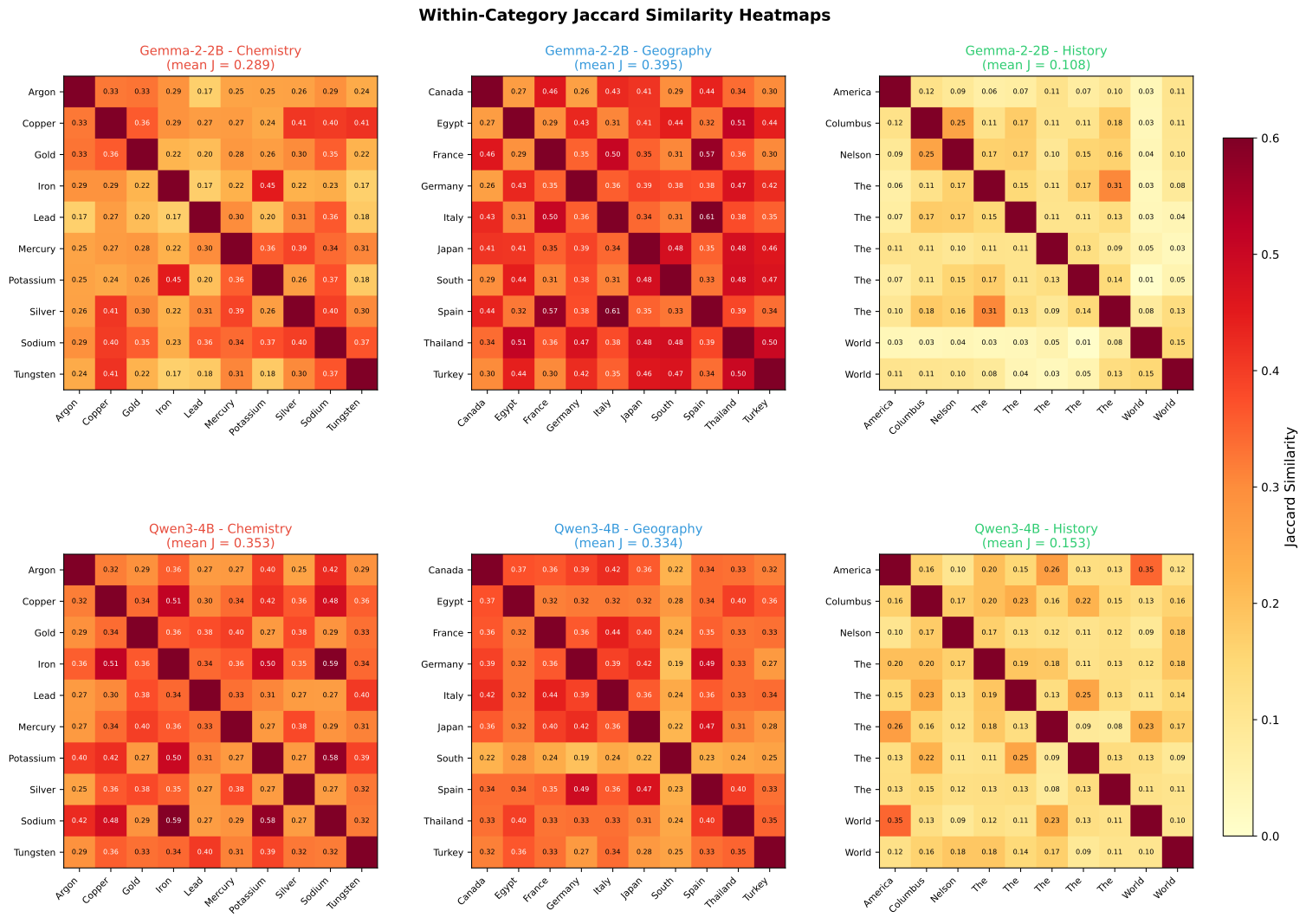
Figure 2. Within-domain circuits share more features than cross-domain. Pairwise Jaccard similarity between circuits within each knowledge domain, computed on bottleneck feature sets. Geography shows the strongest convergence (J = 0.40); history the weakest (0.11). Heatmaps for Gemma (top) and Qwen (bottom) across chemistry, geography, and history.
3.2 Architecture dominanceⓘ
We computed cosine similarity between per-layer activation share profiles (summed activation magnitude at each layer as a proportion of the circuit total) for all pairs of circuits. Within-model similarity averages 0.978 (std = 0.013) across all 30 circuits within each model; profiles cluster tightly within each architecture regardless of knowledge domain. After normalizing both models to a common [0,1] depth scale, between-model similarity drops to 0.696 (std = 0.045; Mann–Whitney p < 1e-6). The gap of 0.282 is an order of magnitude larger than the within-model domain effect (~0.02).
Architecture explains ~14× more variance in layer activation profiles than knowledge domain. Within-category similarity is slightly higher than cross-category (Gemma: 0.984 vs 0.966; Qwen: 0.975 vs 0.956), confirming a small but statistically significant domain effect, but the architecture effect dwarfs it.
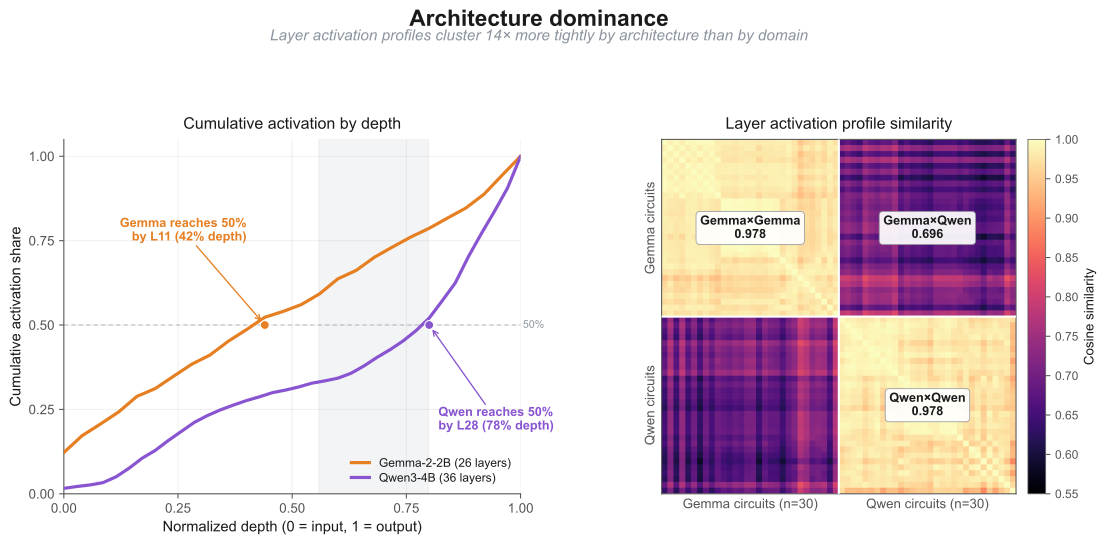
Figure 3. Architecture dominance. Left: Cumulative layer activation profiles show Gemma front-loads 54% of activation into the first half of layers while Qwen back-loads with only 31%: fundamentally different computational strategies, comparable factual recall. Right: Layer activation profile cosine similarity matrix across all 60 circuits. Within-model pairs (Gemma×Gemma and Qwen×Qwen) cluster at 0.978; between-model pairs (Gemma×Qwen off-diagonal blocks) drop to 0.696. Architecture explains ~14× more variance than knowledge domain.
Front-loading vs back-loading
The two models adopt fundamentally different activation accumulation strategies:
- Gemma is front-loaded: 54% of total activation magnitude in the first half of layers (L0–L12). The cumulative share reaches 50% by L11 and 90% by L24.
- Qwen is back-loaded: only 31% of the total in the first half (L0–L17). The cumulative share reaches 50% by L28 and 90% by L34.
These accumulation profiles are consistent across all three knowledge domains: category differences in the 50% threshold layer are only 1–2 layers within each model. Both strategies produce comparable factual recall accuracy: distinct but equally viable solutions to the same retrieval problem.
Bottleneck depth is architecture-dependent
Bottleneck layer position is determined by model architecture, not knowledge domain:
| Category | Gemma Avg Layer | % Depth | Qwen Avg Layer | % Depth |
|---|---|---|---|---|
| Chemistry | L5.5 | 21% | L24.1 | 67% |
| Geography | L5.8 | 22% | L24.6 | 68% |
| History | L6.6 | 25% | L22.0 | 61% |
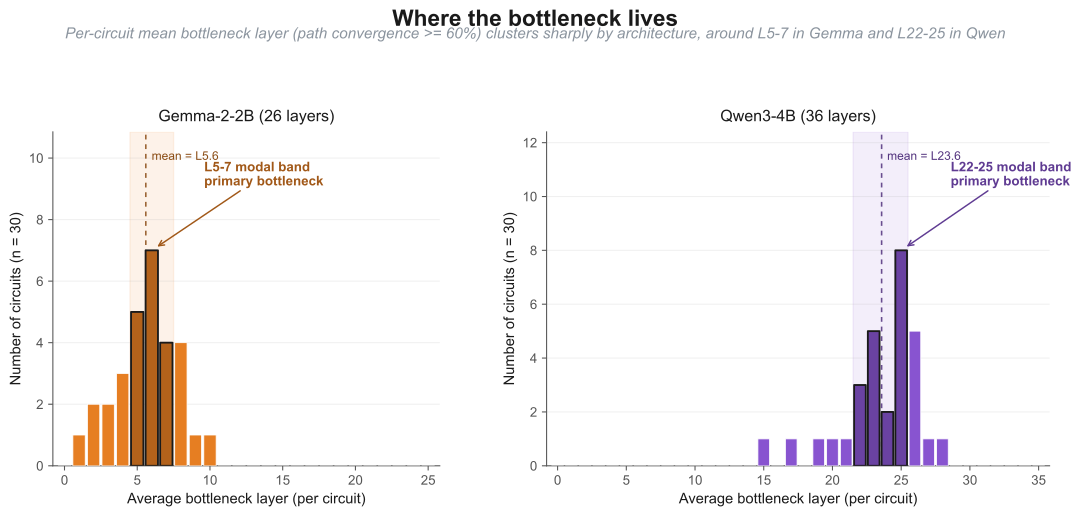
Gemma bottlenecks consistently cluster in layers 5–7 (~22% depth) across all three domains; Qwen bottlenecks cluster in layers 22–25 (~65% depth). Within-model variation across domains is much smaller than between-model variation.
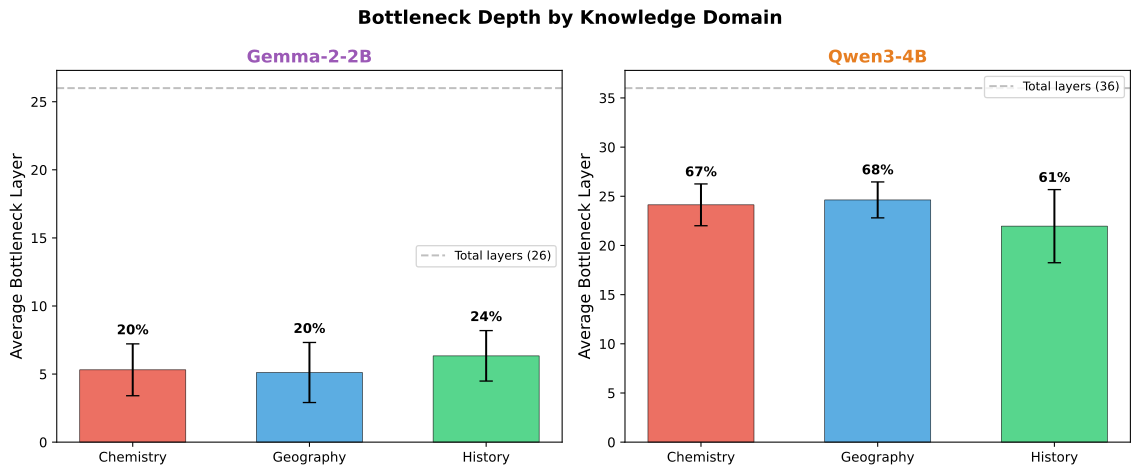
Figure 5. Bottleneck depth is architecturally determined. Across all three knowledge domains, Gemma bottlenecks sit at L5–7 (about 22% depth); Qwen bottlenecks at L22–25 (about 65%). Domain modulates the depth by less than 2 layers.
3.3 Universal bottlenecks
We identified features that serve as bottlenecks across all three knowledge domains. Zero features are shared between Gemma and Qwen, further supporting the architecture-dominance hypothesis.
Gemma Universal Bottlenecks (6)
| Feature | Layer | Description |
|---|---|---|
L0_F1813559 | L0 | Code/file keywords |
L0_F74438300 | L0 | — |
L3_F5150441 | L3 | HTML formatting tags |
L4_F110446948 | L4 | Place names |
L6_F2586668 | L6 | Code snippets |
L24_F88478228 | L24 | Lithuanian place names |
Qwen Universal Bottlenecks (15)
| Feature | Layer |
|---|---|
L15_F8173514424 | L15 |
L16_F1043399704 | L16 |
L17_F6197796762 | L17 |
L18_F11703352509 | L18 |
L19_F6611637508 | L19 |
L24_F457788386 | L24 |
L25_F942235729 | L25 |
L26_F10368215974 | L26 |
L27_F12610705050 | L27 |
L28_F393078712 | L28 |
L29_F89625936 | L29 |
L32_F3158177517 | L32 |
L33_F10240593794 | L33 |
L34_F415944868 | L34 |
| … (15 total) | L15–L34 |
Qwen has 2.5× more universal bottlenecks than Gemma (15 vs 6), and they span a wider layer range (L15–L34 vs L0–L24). This is consistent with Qwen's later, more distributed bottleneck architecture providing more opportunities for cross-domain feature sharing. The notable descriptions of Gemma's universal features ("HTML formatting tags," "code/file keywords," "place names") are structural/format features, not factual knowledge stores. They function as architecture-specific routing infrastructure.
Top bottleneck consistency. L34_F415944868 appears as a bottleneck in 100% of Qwen geography, 100% of Qwen history, and 90% of Qwen chemistry circuits, a domain-agnostic late-layer hub.
3.4 Output convergence vs path divergence
We separately analyzed whether same-domain circuits converge at the output layer (final-layer features) versus along full traceback paths.
| Model | Category | Output Jaccard | Path Jaccard | Ratio |
|---|---|---|---|---|
| Gemma | Chemistry | 0.293 | 0.289 | 1.02 |
| Gemma | Geography | 0.436 | 0.395 | 1.10 |
| Gemma | History | 0.283 | 0.108 | 2.63 |
| Qwen | Chemistry | 0.559 | 0.353 | 1.58 |
| Qwen | Geography | 0.475 | 0.335 | 1.42 |
| Qwen | History | 0.673 | 0.153 | 4.41 |
Output node convergence is consistently higher than path convergence, and the gap is largest for history (4.41× in Qwen). History circuits share the same output features (the model uses similar features to produce the final prediction) even though their intermediate processing paths diverge substantially. The model arrives at a similar "output vocabulary" through different internal routes.
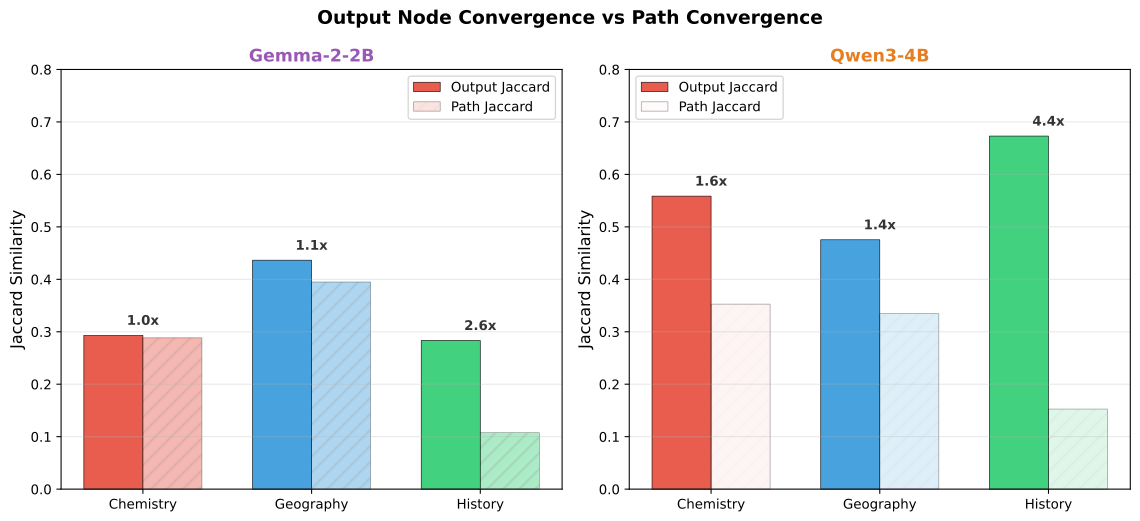
Figure 6. Convergent outputs from divergent paths. Same-domain circuits share output features at up to 4.4× the rate of path-feature overlap (history in Qwen), confirming that different internal routes produce shared output vocabulary. Bar pairs compare output Jaccard (left) and path Jaccard (right) by domain for each model.
This has implications for model editing: intervening at the output layer would affect most circuits within a domain, while intervening at intermediate layers requires more domain-specific targeting.
3.5 The bottleneck penalty
We correlated each layer's activation share with output probability across all 30 circuits within each model, applying Bonferroni correction (Gemma: α = 0.0019 for 26 tests; Qwen: α = 0.0014 for 36 tests).
| Layer | Spearman r | p-value | Direction |
|---|---|---|---|
| L6 (bottleneck) | −0.684 | <0.0001 | Negative (bottleneck penalty) |
| L10 | −0.601 | 0.0004 | Negative |
| L1 | +0.634 | 0.0002 | Positive |
| L13 | +0.601 | 0.0004 | Positive |
| L16 | +0.598 | 0.0005 | Positive |
L6, the primary bottleneck layer, shows the strongest negative correlation (r = −0.684). Circuits with a larger fraction of activation magnitude at the bottleneck layer exhibit lower output confidence. Activation at post-bottleneck layers (L13, L16) positively predicts confidence. We term this pattern the "bottleneck penalty."ⓘ
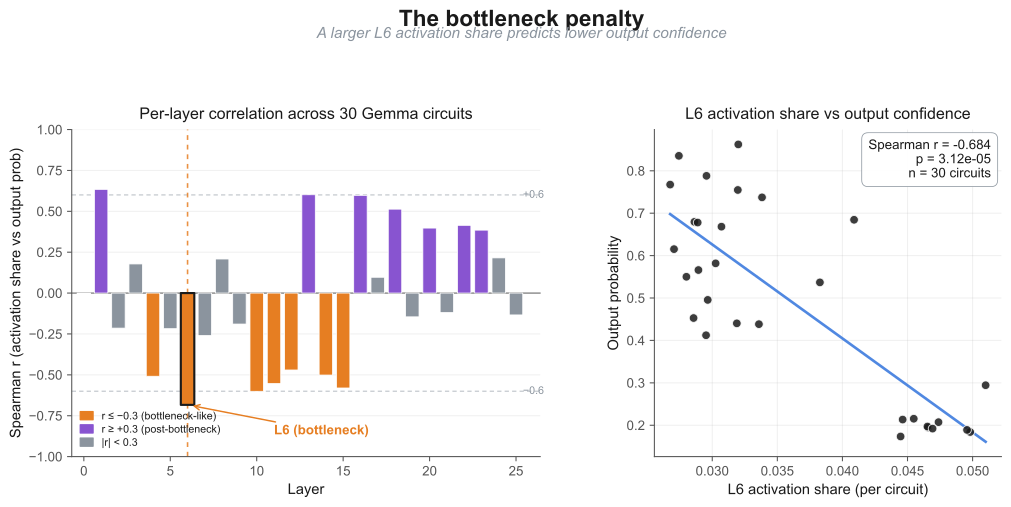
Figure 7. The bottleneck penalty. Per-layer Spearman correlation between activation magnitude fraction and output confidence across 30 Gemma circuits. Bottleneck layer L6 shows a strong negative correlation (r = −0.684, p < 0.0001): circuits concentrating more activation at L6 produce less confident predictions. Post-bottleneck layers L13, L16 reverse the sign (r ≈ +0.60), consistent with information bottleneck framing: heavier compression at intermediate layers reduces information available for downstream evidence accumulation.
Theoretical framing: information bottleneck theory
We interpret this pattern through information bottleneck theory (Tishby & Zaslavsky, 2015; Shwartz-Ziv & Tishby, 2017), which formalizes the tradeoff between representational compression and predictive accuracy. Each layer L computes a representation TL of the input X with mutual information I(X; TL); heavier compression at an intermediate layer reduces what downstream layers can recover. Our correlation is consistent with this prediction: circuits that concentrate more activation magnitude at L6 may be compressing input representations more aggressively, leaving less information for evidence accumulation at L13–L16. Activation at post-bottleneck layers positively predicts confidence, consistent with those layers aggregating information into the final decision.
Important caveat
Activation magnitudes at different layers are computed independently; no conserved quantity is being allocated across layers. The bottleneck penalty is a correlation, not a mechanistic causal claim. Alternative explanations include prompt-difficulty confounds, domain-specific accuracy differences, and feature-selection effects in the traceback algorithm. Direct interventional validation (clamping L6 activation and measuring confidence change) would require local model access not currently available through the Neuronpedia API.
Qwen shows 0 Bonferroni-significant layers (best: L29, r = 0.552, p = 0.0016), consistent with its late-layer architecture decoupling layer-level activation from confidence.
3.6 Circuit redundancy
We extracted the minimum viable circuit connecting input features (early layers, high fan-out) to output features (late layers, high fan-in) for all 60 circuits.
94.1% redundant
Mean reduction across 60 circuits is 94.1% (±1.2%). Only ~6% of nodes participate in shortest input-to-output pathways. Consistent across models and categories.
Single-node bottlenecks
Mean minimal-pathway bottleneck width is 1.1 features. Nearly every circuit funnels through a single critical node in its essential pathway.
0.3% essential weight
Minimal pathway retains just 0.3% of total edge weight. Most edge weight flows through redundant, non-essential connections.
Redundancy → confidence
Gemma: r = 0.642 (p<0.001). More redundant circuits → more confident outputs. Qwen: r = -0.051 (no relationship).
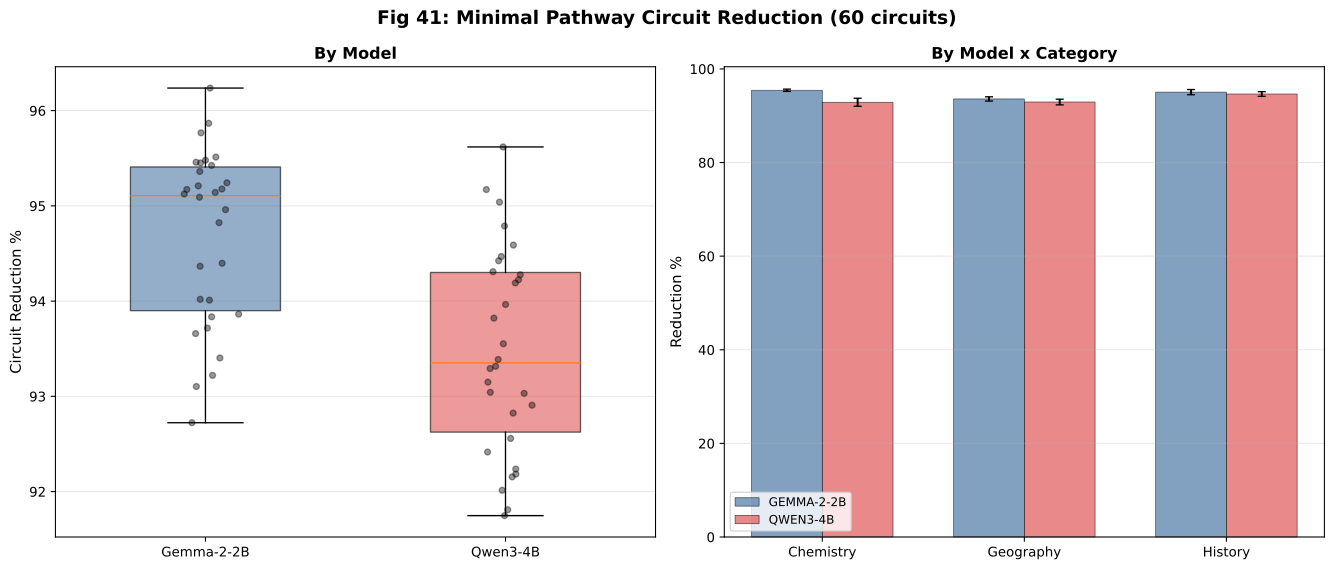
Figure 8. Circuits are 94% redundant. Minimal pathway extraction prunes circuits until only essential edges remain: essential edges carry just 0.3% of total weight, yet preserve output behavior. Gemma essential-pathway bottlenecks concentrate at L22 (median); Qwen at L30.
The Gemma redundancy–confidence correlation suggests a functional role: more redundant circuits may represent more robust, well-established factual memories where the model has encoded multiple parallel pathways to the same answer. This "redundancy-as-robustness" hypothesis aligns with the ensemble interpretation of neural network computation.
3.7 Causal steering: three-tier dissociationⓘ
Across 80 steering experiments on Gemma, we tested whether structural importance metrics on the attribution graph predict behavioral causal influence. Three categories of features were tested: original 5 bottleneck features (Section 6a), 5 cross-circuit-frequency-selected features (Section 6b), and 5 essential-pathway features (Section 6c).
3.7a Initial steering (20 experiments)
Mean logprob shift = 0.045 across all experiments; 50% produced visible text changes. Effects are probability-level perturbations rather than token-flipping interventions. Critical methodological finding: none of the 5 steered features appeared as nodes in their respective circuits' attribution graphs. The threshold-based circuit extraction filters out features that exert causal influence below the display threshold. This visibility gap means circuit-based analysis underestimates the set of causally relevant features.
3.7b Frequency vs causation (D5, 30 experiments)
We expanded by testing 5 high-frequency cross-circuit features (each appearing in 9–11 of the 30 Gemma circuits) on 3 target circuits at strengths ±20.
- 23.3% text change rate for D5 features vs 50% for the original set. Cross-circuit frequency alone is insufficient for predicting causal effectiveness.
- L2_F25751073, the feature appearing in the most circuits (11), produced zero text changes when steered.
- L7_F4828270 (9 circuits) was the most effective new feature (3/6 changed). High frequency does not imply high causal influence.
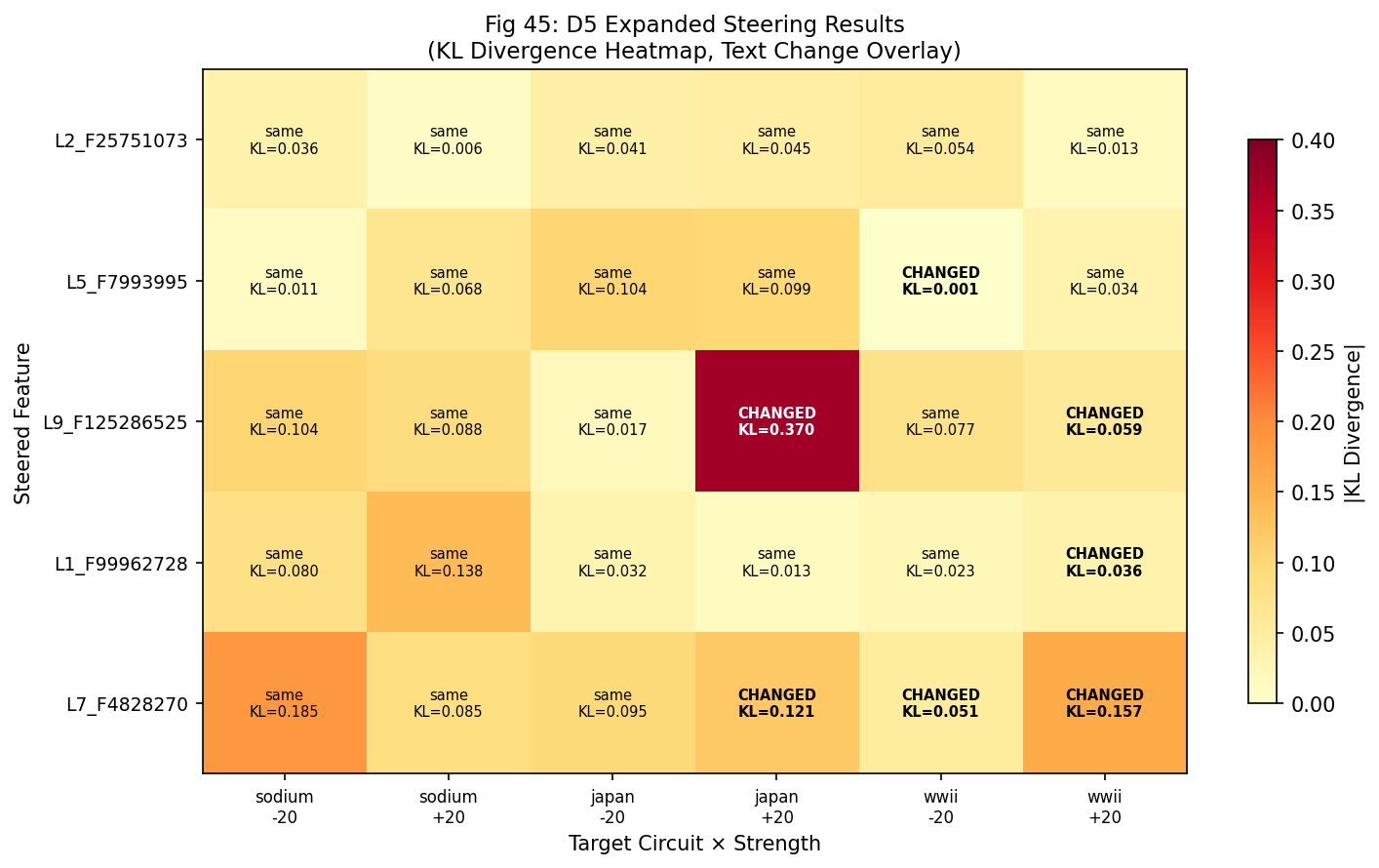
Figure 9. Frequency does not predict causal influence. Expanded D5 steering batch: high-frequency cross-circuit features are not preferentially steerable, and domain susceptibility runs history > geography > chemistry rather than tracking topological centrality. Each point is one of 60 steering trials, color-coded by knowledge domain.
3.7c Essential-pathway steering (30 experiments)
From the 1,000 unique features identified on essential pathways across 30 Gemma circuits, we selected 5 high-frequency essential-pathway features not previously tested.
- 26.7% text change rate, comparable to D5 features off essential pathways (33.3%) and intermediate to D5 features on essential pathways (18.8%).
- Essential-pathway features produce substantially larger distributional perturbations: mean KL divergence = 1.448, vs much lower for D5 features. The strongest single perturbation (L25_F50014975 amplification on geography, KL = 12.72) changed the output from a generic description to the factually correct "Tokyo," suggesting the feature gates factual recall at the output layer.
- Layer depth modulates direction: early pathway features (L0, L1) produced changes exclusively via suppression; late features (L21, L24, L25) responded to both directions.
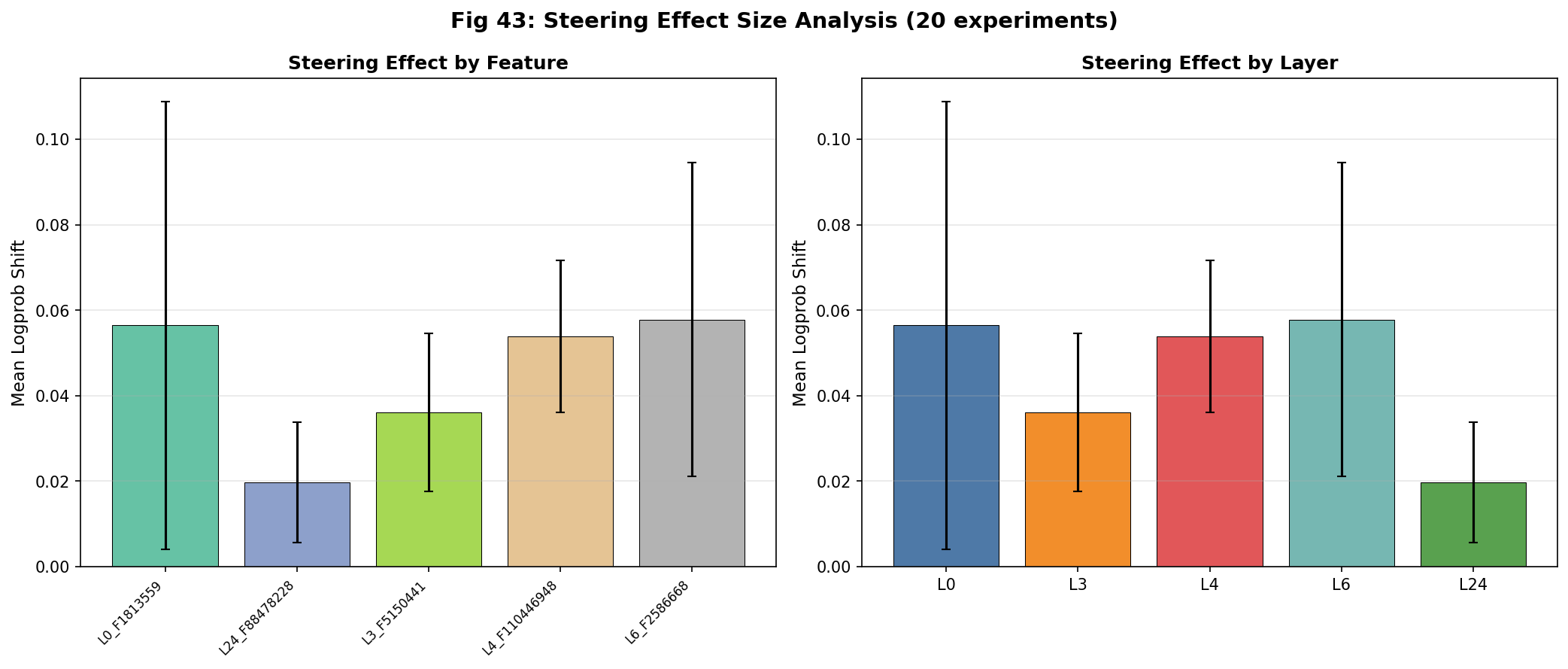
Figure 10. Half of steering interventions produce visible text changes. Initial 20 steering experiments: mean logprob shift = 0.045, and 50% of trials flip the argmax output token. Distributional perturbation strength does not cleanly predict which trials yield surface-level text changes.
Domain susceptibility
Steering susceptibility is highly asymmetric across domains and replicates across all three experiment sets:
Chemistry circuits produce the most deterministic outputs (Na, Fe, Pb are near-certain completions), making them resistant to perturbation. History and geography outputs have more distributional uncertainty, creating room for steering to shift the argmax.
The Three-Tier Dissociation. Combining all 80 experiments yields a three-tier model of feature importance: (1) features on essential pathways perturb probability distributions most strongly (highest KL); (2) features with high cross-circuit frequency are statistically common but not necessarily causal; (3) text-level output changes are governed primarily by output entropy and domain determinism rather than by any single feature-selection criterion. Topology, frequency, and text-level effects decouple.
3.8 Format variation: template > fact > cross-domain
A critical question is whether the within-domain circuit similarity reflects genuine knowledge-domain convergence or merely prompt-template similarity (all chemistry prompts share "The chemical symbol for X is"). To test this, we generated circuits for the same fact (gold) using three different prompt formats.
| Comparison | Mean Jaccard | N pairs |
|---|---|---|
| Same fact, different format (gold × 3) | 0.306 | 3 |
| Different fact, same format (chemistry) | 0.611 | 3 |
| Different fact, same format (geography) | 0.713 | 3 |
| Different fact, same format (history) | 0.156 | 3 |
| Different fact, same format (all domains) | 0.493 | 9 |
| Cross-domain baseline | 0.112 | 27 |
Prompt template drives 1.6× more circuit overlap than factual identity, but the effect is domain-dependent. Chemistry (0.611) and geography (0.713) show strong template-driven convergence, but history (0.156) does not. History circuits are so structurally diverse that the template provides little convergence beyond the cross-domain baseline (0.112). Hierarchy: template > fact > cross-domain for chemistry/geography, but fact > template ≈ cross-domain for history.
Same-fact-different-format Jaccard (0.306) is still 2.7× higher than the cross-domain baseline (0.112), confirming that knowledge domain contributes to circuit structure beyond template effects alone.
This finding does not undermine the architecture-dominance result, which is based on per-layer activation profiles (cosine similarity 0.978 within-model), not feature-level Jaccard. Layer activation profiles are robust to prompt format because they capture the distribution of computation across layers, not the identity of individual features. The format effect operates at the feature-selection level (which specific features are activated) while the architecture effect operates at the computational-structure level (where activation is concentrated).